
 latent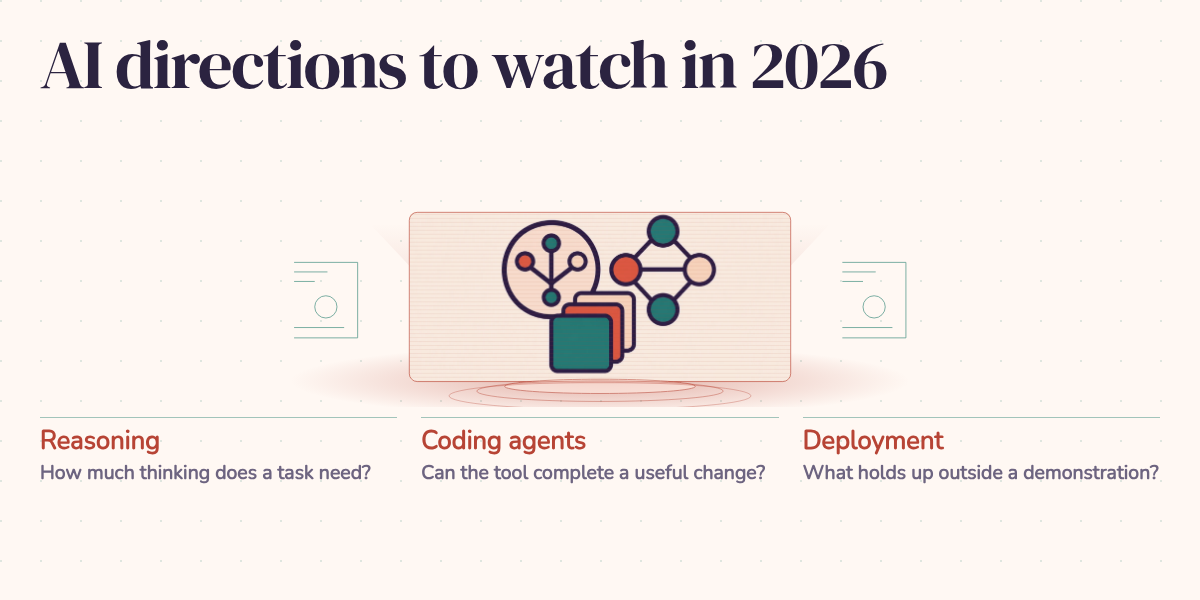
My riskiest prediction for 2026 is that companies will put teams of AI agents into everyday production. A system might read a request, retrieve records, propose an action, and pass it to a person for approval. Getting that sequence to work in a demonstration is one thing. Keeping it useful when a record is missing, a service times out, or two agents disagree is where the prediction becomes expensive.
If I'm right, engineering teams should prepare to operate these workflows. If I'm a year early, they could spend months coordinating agents before proving that one model improves the job. That decision runs through all six forecasts: which improvements are worth preparing for, and what evidence would justify depending on them?
Forecast date: January 26, 2026. Editorial revision: October 20, 2026. The forecasts below retain the January direction and targets. The measurement criteria are later editorial clarifications, not tests registered in January or a report of outcomes. All forecasts concern the end of 2026 unless stated otherwise.
Multi-agent systems enter enterprise production
My January starting point was that 2025 had produced impressive agent demonstrations, while repeatable enterprise operation remained the harder step. I expected 2026 to bring deployments with monitoring, evaluation, and a way to recover when the automation failed.
The architecture I favored was a directed graph of specialized agents. In plain language, the work follows defined routes. One agent retrieves information; another uses it to prepare a result; an orchestrator decides what happens next. Each step has an expected input and output, and consequential actions can stop for human review. Think of a document approval process: knowing who receives the document next matters as much as the quality of each person's contribution.
That design makes failures easier to locate. If a customer record cannot be retrieved, the workflow can retry that step or ask for help before producing a recommendation. A confidence score alone is a weak reason to proceed; the system also needs checks that the required information exists and that the proposed action is allowed.
I expected tracing across agents, interoperable communication protocols, and evaluations of complete tasks to mature alongside adoption. Agent-to-agent communication was my strongest infrastructure bet: handoffs need to preserve meaning and state, not merely deliver a message.
For an October clarification of what would count, I'd look for documented deployments processing recurring business work, with task volumes, completion rates, human interventions, and failures reported over time. Announcements and selected demonstrations would leave this forecast unproven. The original article had no adoption sample or numerical threshold, so a few case studies could establish production use without establishing how widespread it became.
This remains the call I was least confident about. Integration, ownership, permissions, and recovery procedures can take longer than model improvements. My January alternative was that broader adoption would be a 2027 story.
Reasoning becomes an ordinary control
I expected every frontier model to offer reasoning by the end of 2026. My starting distinction was between models that answered directly and models that spent additional computation working through a problem. The next useful improvement would be deciding how much effort a particular request deserved.
A question about an invoice date should not consume the same budget as reconciling a disputed invoice against several contracts. Adaptive reasoning means choosing a faster path for the first task and allowing more work for the second. The attraction is practical: extra computation has to earn its cost and delay through better answers.
The January forecast also included reasoning toggles, thinking-token budgets, and pricing that reflected reasoning intensity. These are related bets, but they are not interchangeable. A provider could expose a general effort setting without letting developers specify an exact token budget.
To assess them, compare documented controls and measured cost, latency, and answer quality on the same tasks. Use the January API behavior as the baseline and keep the provider and model selection explicit. The universal claim about "every frontier model" needs an agreed roster before it can be scored fairly. A new control with no useful quality-versus-cost tradeoff would satisfy the interface prediction while disappointing the engineering one.
The failure mode is overspending. A model can become better at difficult tasks and still be a poor choice for a workload dominated by simple ones.
Coding agents become routine contributors
The workflow I expected was straightforward: an engineer describes a feature and its constraints, an agent changes multiple files, writes tests, and opens a pull request. The engineer reviews it, requests corrections, and decides whether to merge. My forecast was that the range of tasks suitable for this process would widen during 2026.
I also made a much bolder call: serious coding models would saturate SWE-bench, and attention would move toward operational measures. That benchmark prediction belongs on the record. A fair assessment needs a named SWE-bench variant and consistent evaluation settings; scores from different variants cannot establish saturation.
The operational question is easier to explain. If an agent produces a pull request in ten minutes and an engineer spends two hours repairing it, the generation speed tells us very little. Track the share of assigned tasks that reach an accepted merge, review and rework time, and defects found afterward. Compare similar task types against the January workflow. Existing code with incomplete documentation is an especially useful test because the agent must discover constraints that the prompt did not spell out.
This forecast can fail even while the generated code improves. Review may become the bottleneck, or agents may repeatedly miss assumptions that are obvious to people familiar with the system.
The staffing consequence deserves care. I argued for using AI to help junior developers learn and deliver work. Removing their opportunities to practice would also remove opportunities to develop future senior engineers. The original warning about having no senior pipeline "three years from now" expressed that concern, not a measured workforce timeline.
Open-weight models narrow the useful gap
My January bet was that open-weight models would become close enough to the best closed models for most production work. I put that ambition at "80% of workloads that drive real business value." That was a forecast target, not a measured market share or an established count of workloads.
The technical reason was that useful improvements need not come only from enlarging a base model. The DeepSeek-R1 paper described reinforcement learning that improved reasoning and the release of models distilled from R1. It provided a concrete reason to take training methods and post-training seriously. It did not establish that a clever recipe universally cancels out a compute disadvantage.
Access to weights also gives operators room to fine-tune a model, reduce its numerical precision to fit available hardware, and optimize inference for a particular task. Those choices can help with latency or data constraints. They also create operational work that an API customer can leave to a provider.
To test the 80% ambition, define a workload set first and compare open and closed options against the same quality, latency, and cost requirements. Include the cost of operating the open model. A model that passes a document-classification workload need not pass a difficult planning task. Without a representative workload set, the industry-wide percentage remains unscorable.
I expected more organizations to run local models where that control paid off and retain closed APIs for tasks that justified them. The forecast would disappoint if the apparent model savings were consumed by quality gaps or operating overhead.
Inference becomes another ten times cheaper
The numerical January prediction was another 10x fall in inference cost during 2026. Falling costs were the direction I felt most confident about; the exact multiplier deserves a stricter test.
There was good historical reason to expect improvement. Stanford's 2025 AI Index reported a fall from $20 to $0.07 per million tokens between November 2022 and October 2024 for models reaching roughly GPT-3.5-level performance on MMLU. That is a specific capability comparison over a specific period. It does not establish the original article's blanket claim that inference became 10x cheaper during 2025.
My January explanation combined hardware deployment, including Google's TPU v6, Amazon Trainium2, and NVIDIA Blackwell, with inference optimizations and competition among providers such as Groq, Fireworks, and Together. Techniques such as speculative decoding, sparsity, and better management of cached attention state were reasons to expect efficiency gains. Their contribution to a customer's bill would still depend on the workload and provider.
The useful October test is to choose a fixed task and acceptance standard, then compare its January and December cost. Keep input and output volumes, reasoning, retries, and caching conditions visible. Ten times cheaper means a cost no greater than one tenth of the baseline. A cheaper token paired with enough extra attempts can leave the cost of a successful task unchanged.
I also predicted context windows moving toward 10 million tokens. That capacity target should be assessed separately from cost and accuracy. Being able to submit a large collection of documents does not establish that a model can reliably find every relevant detail in it, or that retrieval is no longer useful.
The product opportunities I had in mind were continuous codebase monitoring, meeting summaries with the full transcript available, and repeated document compliance checks. Each becomes more attractive when the cost of an acceptable result falls. More expensive reasoning, weak utilization, or pricing changes could spoil the 10x forecast even if hardware efficiency improves.
AI fatigue changes adoption decisions
My final forecast was a backlash against constant migration and features that added friction. Developers would settle on stable tools for longer. Users would become less patient with AI features that made familiar tasks slower or less predictable. That was a judgment about the direction of adoption, not a survey result.
The practical test is behavior: whether teams extend upgrade cycles, whether users keep optional AI features enabled, and whether products retain those features after measuring completion time and errors. Compare the same teams or products over time. A collection of irritated posts would be a poor substitute for that evidence. The prediction could fail if useful improvements arrived quickly enough to justify the disruption.
Regulation was another source of work in the January forecast, though the original wording compressed the timetable too far. The EU AI Act entered into force in August 2024. Article 113 of the original regulation set a general application date of August 2, 2026, with earlier and later exceptions. It was never a single switch making every obligation newly enforceable in 2026. This is the historical basis of the forecast, not a current compliance calendar.
My expectation was that documentation, evaluation, and auditability would take more engineering attention. The amount would depend on the system and the rules applying to it. Teams able to show time saved, fewer errors, or useful revenue would have a better case for keeping an AI feature through both internal scrutiny and user fatigue.
What these bets should change
Taken together, the forecasts favor preparing for cheaper, more capable models while being selective about the complexity built around them. They support keeping a representative evaluation set, recording the cost of completed work, and making human review useful enough to catch failures. Those investments help whether a particular provider or architecture wins.
The riskiest decision is committing an organization to coordinated agents before proving the underlying workflow. Start with work whose result you can judge, record where it fails, and add separate agents when their responsibilities make the process easier to operate. Lower inference prices can make experimentation cheaper; they cannot decide whether the experiment deserves to become a dependency.
That is how I would use these predictions to make a decision. By the end of the year, the question is whether a task can be completed more reliably or at an acceptable lower cost, with the work of operating and reviewing the system included. If those measures do not improve, a forecast coming true on a product announcement has done little for the people using it.